
Peace on Earth
The Spirituality of the Peacemakers

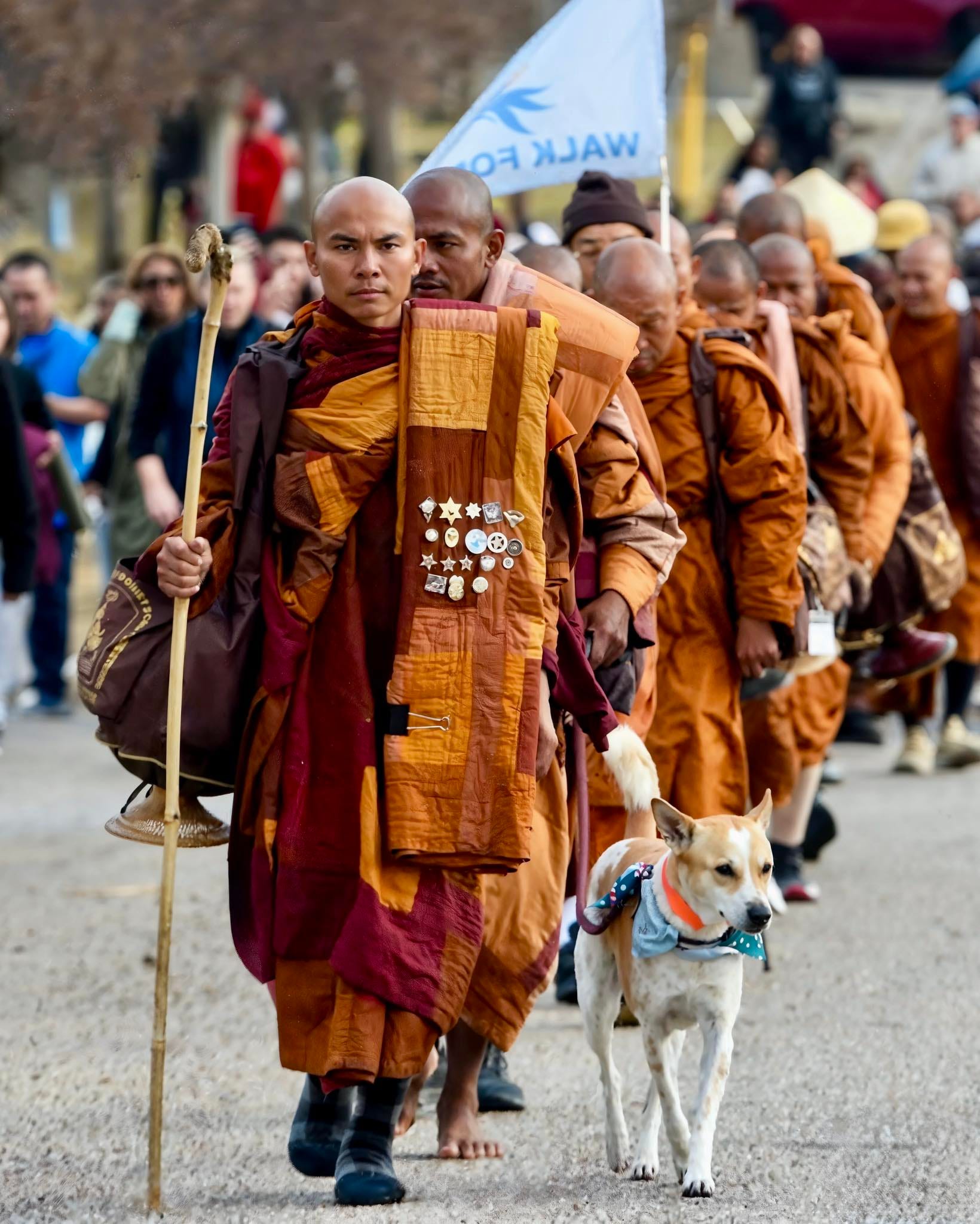
Photo Credit: From the Walk for Peace Page
I know that the world is hard to bear at the moment, but I have been following the Buddhist monks’ walk for peace with their dog, Aloka across the South of the United States, and something stirred in me that I hadn’t felt in a while: hope.
The contrast of these monks walking in winter for peace, while people who claim Christ are in the highest office in the United States, waging war for resources and land, could not be more stark. This has made me reflect on how peace work, positive peacebuilding and peacemaking, are the antidotes we need in the world.
Peace work itself has a sense of spirituality, or presence, which you can see as the monks walk for peace and the crowds of people are moved to tears. To be clear, I don’t mean religion. Some of the most peaceful and peace-making people I know are atheists or agnostics, while some of the most religious people in the world are also the most hateful war-mongering people out there.
Still, for lack of a better word, there is a spirituality that sets people of peace apart. One can belong to a faith tradition or have no faith at all, yet there is something deeply spiritual about those who commit themselves to positive peace, not silencing the oppressed, but the real work of liberation, equity and flourishing for all.
I believe this is what Jesus of Nazareth meant in the Beatitudes when he said, “Blessed are the peacemakers.” I do not believe Jesus came to start a religion. There is no evidence of that. The Christian texts were written down over a hundred years after Jesus walked the earth. The canon was hand picked by religious leaders and some were likely chosen because of their ability to control people. Jesus did talk about his ‘ekklesia’ in the Gospels, a Greek word meaning assembly, but that is not a religion, that is a movement. It was the Roman Empire’s adoption of the Way, the movement of Christ-followers in the third century, that turned the movement into a static religion. And not just any religion, but one that propped up the empire and justified endless wars and conquests, much as Christianity and other religions can do today.
When Jesus speaks of “blessed are the peacemakers,” he is drawing on two Greek words used for “peace” and “maker.” The first is a feminine noun, eirēnē, meaning “oneness, peace, quietness, rest.” The second is a verb, poieō, meaning to make, cause, construct, or act. Together, they can be understood as “one who makes peace” or “one who constructs rest.” Ultimately, the making of rest, the making of peace, is the way of mutual flourishing. It is the interconnected way of the universe.
We can look to the mycelium which is the vast, underground network of fungal threads that forms the connective tissue of forest ecosystems, linking trees and plants through their root systems in a scientifically documented symbiotic relationship. Mycelium is also known as the “wood wide web,” mutual flourishing for the forest. Through this living infrastructure, mycelium facilitates the exchange of nutrients, water, and biochemical signals, allowing trees to communicate, share resources, warn one another of threats, and support seedlings or injured neighbors, thereby increasing the forest’s resilience and collective health. When peacemakers come together to be like mycelium, not around competition but community, we mirror the forests’ architecture of mutual care where life flourishes through interdependence, cooperation, and quiet generosity.
Jesus speaks of a reward of the peacemakers and that is to be named a child, or descendant, of God (theos). The children of God, then, are those who seek peace, move in community, resist empire and create networks of mutual flourishing. The time may be dire but a gentle reminder: the rhythms of the universe are always life, death, and rebirth; nothing is static, and everything changes. Although the time right now seems hopeless, I genuinely believe that a revolutionary era of peace is being born. Now is the time to be like mycelium. To get in real life, dig deep in communities, and create networks of mutual flourishing so that future generations will be inspired by the blueprints of a flourishing world we created during the darkest times.